





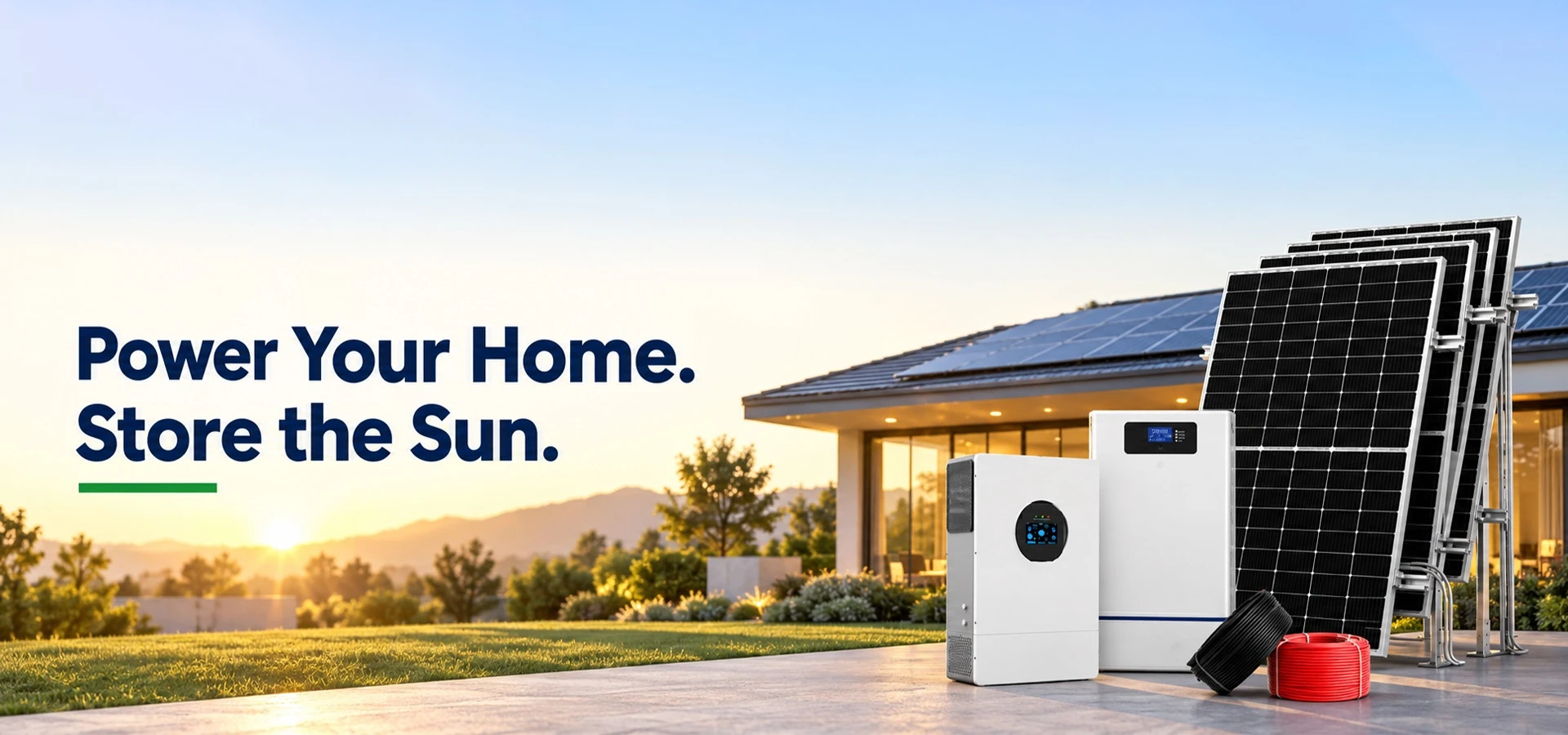
Integrated Residential Energy Solutions
Why Choose SIY Solar for Home Solar Systems?
Matched residential solar systems for grid-tied, hybrid and off-grid applications, selected around household loads, roof area, local voltage, backup priorities and compatible PV, inverter and battery components.
System-Level Compatibility
PV modules, solar inverters, LiFePO4 battery options, BMS communication and monitoring functions are matched according to the selected system architecture. Battery cycle life and usable capacity vary by model, depth of discharge and operating conditions; project datasheets should be used for final confirmation.
One-Stop Solar System Supply
Source solar panels, grid-tied, off-grid or hybrid inverters, home battery storage, mounting structures, wiring and monitoring options through one project channel. This helps reduce component-matching work and multi-supplier coordination for residential solar projects.
Market-Specific Configuration
With export experience in Europe, Southeast Asia and the Middle East, SIY Solar can discuss voltage, frequency, system capacity, mounting, monitoring, labeling and packaging requirements for different markets. Applicable local grid codes and certification documents must be confirmed before ordering.
-
![Solar Energy System]() Solar Energy SystemComplete Solar Energy System — Reliable Power, Lower Energy CostsThe SIY Solar Energy System is a complete, ready-to-install power solution that combines high-efficiency solar panels, a smartread more
Solar Energy SystemComplete Solar Energy System — Reliable Power, Lower Energy CostsThe SIY Solar Energy System is a complete, ready-to-install power solution that combines high-efficiency solar panels, a smartread more -
![Hybrid Solar Energy System]() Hybrid Solar Energy SystemSIY‑Solar hybrid solar system integrates photovoltaic power generation, LiFePO4‑battery energy storage, mains‑grid connection and intelligent energy management. It enables flexible switching betweenread more
Hybrid Solar Energy SystemSIY‑Solar hybrid solar system integrates photovoltaic power generation, LiFePO4‑battery energy storage, mains‑grid connection and intelligent energy management. It enables flexible switching betweenread more -
![Residential Solar Energy System]() Residential Solar Energy SystemResidential Solar Energy SystemA complete home energy solution combining solar panels, a hybrid inverter, battery storage and intelligent power management. It generates clean electricity during theread more
Residential Solar Energy SystemResidential Solar Energy SystemA complete home energy solution combining solar panels, a hybrid inverter, battery storage and intelligent power management. It generates clean electricity during theread more -
![Solar Panels With Battery With Inverter]() Solar Panels With Battery With InverterSolar Panels with Battery and InverterA complete solar power package that generates clean electricity, stores surplus energy and converts it into reliable power for your home or business. The systemread more
Solar Panels With Battery With InverterSolar Panels with Battery and InverterA complete solar power package that generates clean electricity, stores surplus energy and converts it into reliable power for your home or business. The systemread more -
![Off-grid Solar Energy System]() Off-grid Solar Energy SystemOff-Grid Solar Energy SystemA reliable, fully independent power solution for homes, remote sites and commercial projects without stable grid access. SIY Solar’s system combines high-efficiency solarread more
Off-grid Solar Energy SystemOff-Grid Solar Energy SystemA reliable, fully independent power solution for homes, remote sites and commercial projects without stable grid access. SIY Solar’s system combines high-efficiency solarread more -
![Off Grid Solar System]() Off Grid Solar SystemOff-Grid Solar SystemA complete independent power solution combining solar panels, battery storage, an off-grid inverter, mounting hardware, protection and system monitoring. It delivers reliableread more
Off Grid Solar SystemOff-Grid Solar SystemA complete independent power solution combining solar panels, battery storage, an off-grid inverter, mounting hardware, protection and system monitoring. It delivers reliableread more -
![Residential Solar Systems]() Residential Solar SystemsResidential Solar SystemA complete home energy solution with solar panels, a matched inverter and optional lithium battery storage. Designed around your household’s actual electricity use, it helpsread more
Residential Solar SystemsResidential Solar SystemA complete home energy solution with solar panels, a matched inverter and optional lithium battery storage. Designed around your household’s actual electricity use, it helpsread more -
![Solar Power Station]() Solar Power StationSolar Power StationOur Solar Power Station is an all-in-one portable energy solution that combines rechargeable battery storage, a power inverter and solar charging. It delivers clean, quiet andread more
Solar Power StationSolar Power StationOur Solar Power Station is an all-in-one portable energy solution that combines rechargeable battery storage, a power inverter and solar charging. It delivers clean, quiet andread more -
![Solar Power For Home]() Solar Power For HomeSolar Power for HomeOur Solar Power for Home solution is a complete residential energy system combining high-efficiency solar panels, secure mounting, a matched inverter, electrical protection andread more
Solar Power For HomeSolar Power for HomeOur Solar Power for Home solution is a complete residential energy system combining high-efficiency solar panels, secure mounting, a matched inverter, electrical protection andread more


Home Solar System Specifications
Reference Configuration
The following specifications describe typical 3kW to 10kW residential solar system configurations. Exact PV array size, inverter rating, battery capacity and electrical parameters are confirmed according to the project load and installation conditions.
| Item | Reference Specification |
|---|---|
| System Architecture | Grid-tied, off-grid or hybrid home solar power system |
| Primary Application | Residential self-consumption, backup power and remote household electricity supply |
| PV Array Capacity | Typically 3kW–10kW; larger project-based configurations available |
| PV Module Type | Monocrystalline solar panels; PERC or other high-efficiency options by model |
| Module Efficiency | Up to 23.5%, depending on the selected module model and test conditions |
| Battery Chemistry | LiFePO4 lithium battery options with compatible battery management system |
| Battery Capacity | Typically 5kWh–20kWh; expandable or project-specific options subject to model compatibility |
| Inverter Type | Grid-tied, off-grid or hybrid solar inverter selected for the system architecture |
| Inverter Power | Typically 3kW–10kW, sized according to continuous and surge load requirements |
| Output Voltage | 110V / 220V options; final voltage must match the target-market electrical system |
| Frequency | 50Hz / 60Hz options |
| Installation | Roof-mounted or ground-mounted PV array, subject to site survey and structural conditions |
| Monitoring | Mobile app or other monitoring options, depending on the selected inverter and communication module |
| Customization | System sizing, component configuration, branding, labeling and packaging for qualified OEM/ODM projects |
| Reference Service Life | PV modules: up to 25 years; battery service life is model-, usage- and environment-dependent |
Technical values are reference ranges, not a universal product guarantee. Final specifications, warranty terms, certifications and compatible component models should be stated in the quotation, datasheet and supply agreement.
Advantages of a Household Solar Energy System
A correctly sized residential solar power system can improve solar self-consumption, reduce dependence on purchased electricity and support selected household loads. Actual savings and backup duration depend on local tariffs, solar resources, usage patterns and system design.
Use More Solar Energy at Home A home solar panel system supplies daytime household loads directly. When battery storage is included, suitable surplus generation can be stored for later use, helping increase on-site consumption of solar electricity.
Flexible Backup and Off-Grid Options Hybrid and off-grid solar systems can support designated circuits during grid interruptions or provide electricity where utility access is unavailable. Backup power is limited by inverter output, battery capacity and the connected loads.
Scalable Residential Energy Design Solar array and home battery capacity can be selected around available roof area, daily energy consumption and future load plans. Expansion capability depends on inverter, battery and electrical-system compatibility.
Monitoring and Energy Visibility Compatible monitoring platforms can display solar generation, battery status, household consumption and system alarms. Available functions depend on the inverter, meter, communication hardware and selected configuration.
Types of Home Solar Power Systems
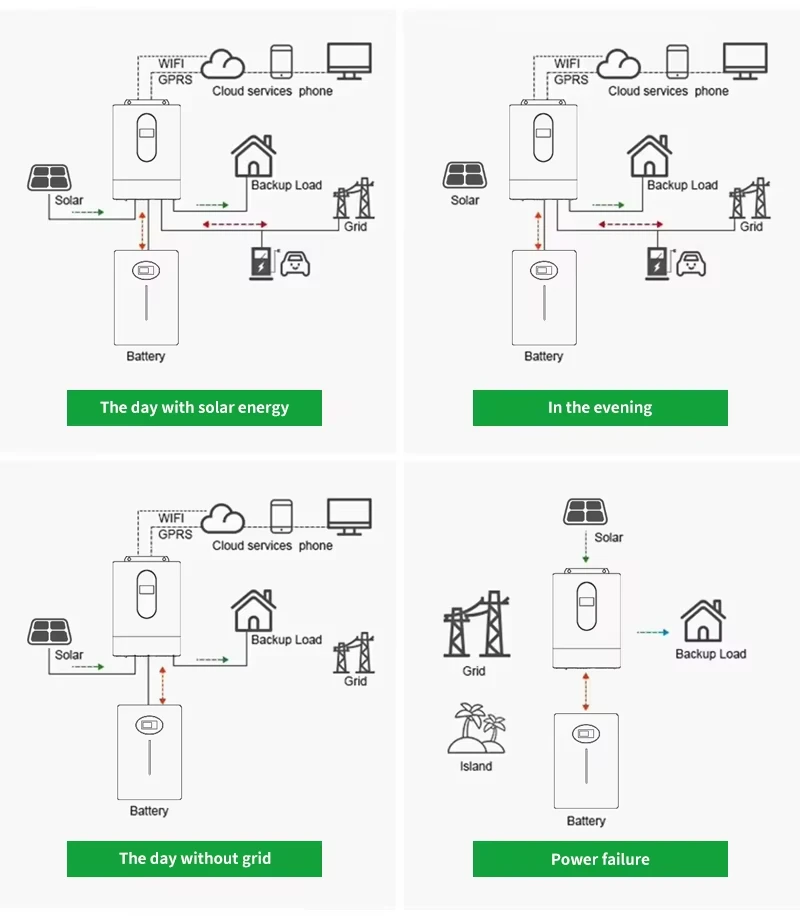
The right household solar system architecture depends on grid availability, electricity tariffs, backup requirements and local interconnection rules.
Grid-Tied Home Solar System
Uses solar electricity for household loads while remaining connected to the utility grid. Surplus electricity may be exported only where the local utility, meter and regulations support grid export or net metering. A standard grid-tied inverter normally shuts down during an outage unless a compatible backup solution is installed.
Off-Grid Solar System for Home
Operates independently of the utility grid and normally combines PV modules, an off-grid inverter, battery storage and appropriate protection devices. System sizing must consider daily consumption, seasonal solar irradiation and appliance startup power.
Hybrid Solar System with Battery
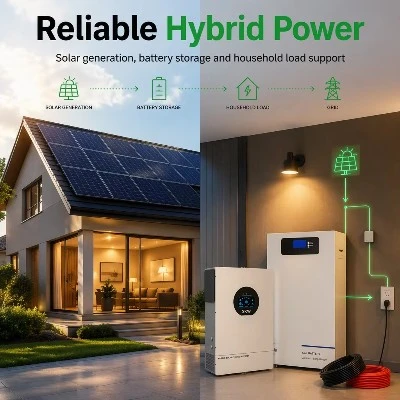
Integrates solar generation, grid power and LiFePO4 battery storage through a hybrid inverter. It can improve self-consumption and support selected backup loads when the inverter, transfer arrangement and battery are configured for backup operation.
Complete Residential PV Solution
Household Solar Energy System Components
A complete home solar kit is more than a group of individual products. Electrical ratings, communication protocols, installation hardware and protection devices must be coordinated as one system.
Solar Panels and Mounting Structure Photovoltaic modules convert sunlight into direct-current electricity. Roof or ground mounting is selected for the roof material, available area, wind and snow conditions, orientation and structural requirements of the installation site.
Solar Inverter and Energy Control The inverter converts DC electricity from the PV array into AC electricity for household loads. Grid-tied, off-grid and hybrid inverter functions differ, so the model must match the system architecture, voltage, frequency, load profile and local grid requirements.
LiFePO4 Home Battery Storage A residential battery stores available energy for later use. Capacity should be based on usable energy, required backup duration, charge and discharge limits, depth of discharge, expected temperature and compatibility with the selected inverter.
Cabling, Protection and Monitoring A complete residential solar system may include DC and AC cables, connectors, combiner or distribution equipment, isolators, breakers, surge protection, meters and communication modules. The final protection design must follow applicable local electrical standards.
How a Household Solar Energy System Works
Energy flow changes according to whether the residential solar system is grid-tied, off-grid or hybrid, but the basic operating process is as follows.
- Sunlight reaches the photovoltaic cells, and the solar panels generate direct-current (DC) electricity.
- The inverter converts DC electricity into alternating-current (AC) electricity compatible with the configured household electrical system.
- Available solar electricity is used to supply connected household loads through the electrical distribution system.
- In a compatible hybrid or off-grid system, available surplus solar generation can charge the battery within the configured operating limits.
- In a grid-connected system, permitted surplus electricity may be exported through an approved meter where local utility rules allow it.
- When solar generation is insufficient, the system may use stored battery energy or grid electricity according to its architecture and operating settings.

PV Module Selection
Solar Panel Types for Home Solar Systems
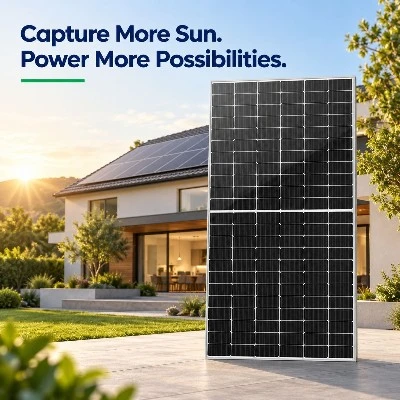
Monocrystalline modules are commonly selected for modern residential solar systems because their higher power density is useful where roof space is limited. Final selection should be based on the actual module datasheet, not cell type alone.
| Comparison | Monocrystalline Solar Modules | Polycrystalline Solar Modules |
|---|---|---|
| Typical Appearance | Usually black or dark grey cells | Usually blue-toned cells |
| Power Density | Generally higher output per square metre, depending on module design | Generally lower output per square metre and may require more installation area |
| Residential Roof Use | Often preferred where roof area is limited or a uniform dark appearance is desired | Can be considered where sufficient area is available and project economics support the choice |
| Temperature and Shading | Both technologies lose output as cell temperature rises and are affected by shading. Compare the specific module temperature coefficient, bypass-diode design and warranty data. | |
| SIY Solar Configuration | Primary option for the referenced 3kW–10kW+ home solar system range | Availability should be confirmed for the individual project |
Residential Load Scenarios
Applications of a Household Solar Energy System
A home solar power system can support many residential loads, but no appliance should be assumed compatible without checking continuous power, startup surge, daily energy use and required operating time. The system should be sized from a real load schedule.
Essential Household Loads
Lighting, internet equipment, phone charging, televisions and selected sockets can be grouped as essential circuits for everyday use or planned backup.
Refrigeration and Kitchen Loads
Refrigerators, freezers and selected kitchen appliances can be supported when inverter surge capacity and total daily energy consumption are properly calculated.
Air Conditioning and Heat Pumps
High-power HVAC equipment requires careful inverter, PV and battery sizing. Operating time depends on appliance rating, climate and available solar generation.
Household Water Pumps and Motor Loads
Water pumps and other motor-driven household equipment may have high startup current. Motor type, surge power, operating time and expected duty cycle must be included in system design.
Home Office and Connectivity
A residential solar system with battery backup can support routers, computers, monitors and other selected communication equipment during suitable operating conditions.
EV and Battery Charging
Solar-assisted EV charging is possible with an appropriately sized PV array, inverter and electrical installation. Charging power should be coordinated with other household loads.
Remote and Off-Grid Homes
Off-grid solar kits can provide electricity where utility access is unavailable, provided seasonal solar resources, battery autonomy and backup strategy are considered.
Planned Backup Circuits
A hybrid solar system with battery can prioritize selected loads during an outage. Whole-home backup requires a larger, purpose-designed system and compatible transfer equipment.
System capability is determined by the selected components and site conditions. “3kW”, “5kW” or “10kW” describes nominal power, not the number of hours every household appliance can operate.
Household Solar System Customization
Load-Based System Sizing Custom configurations are available from smaller residential backup systems to 3kW, 5kW, 8kW, 10kW and larger project-based home solar solutions. Recommended sizing starts with daily energy consumption, peak load, motor surge and backup duration.
Matched PV, Inverter and Battery Options Monocrystalline PV modules, inverter type and LiFePO4 battery capacity can be selected around roof area, solar resources, grid access and required household autonomy.
Information Required for a Proposal Provide the installation country, voltage and frequency, monthly or daily electricity use, appliance list, roof or ground details, required backup loads and target order quantity.
On-Grid, Off-Grid and Hybrid Configuration
System architecture, inverter rating, battery capacity, 110V/220V output, 50Hz/60Hz frequency and monitoring options can be discussed for different residential power conditions.
Roof and Ground Mounting Options
Mounting structures can be selected for tile roofs, metal roofs, flat roofs, pitched roofs or suitable ground installations. Final structural and wind-load verification remains site-specific.
OEM, ODM and Wholesale Support
For qualified distributor and project orders, available services may include system configuration, product branding, labels, manuals and packaging. Scope, MOQ, lead time and applicable documents are confirmed per quotation.
Home Solar System Packaging and Shipping
Order Fulfilment
Packaging and transport are planned according to the selected solar panels, inverter, battery, mounting hardware, order quantity and destination requirements.
| Item | Available Arrangement |
|---|---|
| Standard Packaging | Export cartons and pallets; component-specific protective packaging is used according to product type |
| Additional Protection | Wooden pallets or cases, corner protection, moisture protection and strengthened packing where required by the shipment plan |
| Transport Options | Sea freight, air freight or land transport, subject to destination, cargo classification, cost and delivery requirements |
| Order Documents | Packing list, commercial documents, manuals and product-specific technical or compliance documents as agreed in the order |
| Shipping Confirmation | Final packing method, quantity, dimensions, weight, shipping terms and battery-transport requirements are confirmed before dispatch |
As one of the most professional home solar system enterprises in China, we're featured by quality products and good service. Please rest assured to buy bulk high-grade home solar system in stock here from our factory. We also accept customized orders.
household solar panel system, solar energy for household use, solar system for household use