






When Are Bifacial Solar Panels Worth It for Ground-Mount Projects?
A practical guide for project developers, EPC contractors, installers and module buyers.

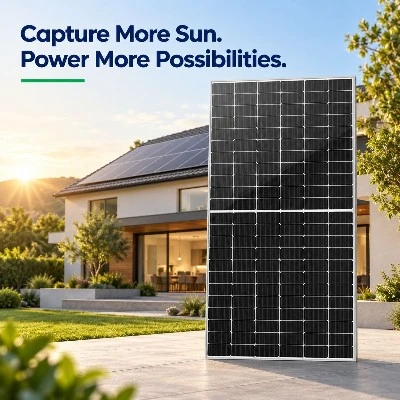
Bifacial module visual from SIY Solar supplied materials. Actual product technology, dimensions and electrical ratings depend on the selected model.
Quick answer
Bifacial solar panels are worth evaluating when a project can deliver useful light to the module's rear side and the modeled energy gain justifies any added module or balance-of-system cost. The result depends on ground reflectivity, module height, row spacing, tilt, rear-side shading and site irradiance. Bifaciality in a datasheet is not a guaranteed project gain.
- Bifaciality vs. energy gain
- Site conditions that affect rear-side output
- Mounting and layout decisions
- Check the project economics
- What to verify before ordering
Bifaciality is a module property; energy gain is a project result
A bifacial module can generate electricity from light reaching both its front and rear surfaces. The module's bifaciality factor describes the relative response of the rear side under specified test conditions. It does not tell a buyer how much extra annual energy a completed project will produce.
System-level rear-side irradiance depends on the ground's reflectivity (often expressed as albedo), array geometry, module elevation, row spacing, tilt, nearby obstructions and shading from the mounting structure. Modeling tools such as NREL's System Advisor Model documentation expose several of these as inputs to bifacial PV calculations. Use model-specific datasheets and a project-specific energy model to estimate yield.
Site conditions that can help-or limit-rear-side output
- Ground surface: Bright, reflective surfaces return more light than dark soil or vegetation, but any surface treatment should be evaluated for cost, drainage, dust, maintenance and durability.
- Clearance and tilt: Elevation and module angle affect how much reflected and diffuse light reaches the rear surface. The structural design and wind loads may limit how far the array can be raised.
- Row spacing: Tight spacing can increase rear-side shading from neighboring rows. Greater spacing can help irradiance access but uses more land and can change project cost.
- Racking and obstructions: Rails, purlins, cables, junction boxes and nearby objects can shade parts of the rear surface. Include the actual mounting geometry in yield analysis.
- Weather and seasonal variation: Cloud cover, sun angle, snow or seasonal ground conditions can change the amount and distribution of rear-side irradiance over a year.

Module construction illustration from supplied product materials. Verify whether the quoted bifacial module uses glass-glass construction and check its current datasheet and installation manual.
Coordinate module choice with mounting design
For a ground-mount project, choose the module and mounting structure as a coordinated package. Confirm module dimensions, weight, clamp zones, connector and cable details, maximum system voltage, current ratings and mechanical load limits. Then check that the rear side remains accessible and that the racking design does not create avoidable shading.
Do not set row pitch or ground clearance from a generic "bifacial gain" percentage. The project engineer should model the proposed site layout and compare feasible alternatives. A higher structure or wider row pitch may improve rear-side irradiance but can also increase steel or aluminum quantities, foundations, land use, wind exposure or installation costs.
Compare energy value against the full project cost
Ask the project team to compare bifacial and monofacial options using consistent assumptions: location, DC capacity, inverter clipping, degradation, losses, mounting design, energy tariff and financing. Review annual energy and time-of-day generation, not only a headline gain value. If the economic case depends on a reflective surface or a specific mounting height, include the cost and upkeep of that design in the comparison.
Request the modeling assumptions and sensitivity cases. At minimum, test plausible ranges for albedo, rear-side shading and row spacing. This helps buyers understand how robust the estimate is if site conditions differ from the design assumptions.
Procurement checklist for bifacial PV modules
| Check | Ask the supplier or project engineer |
|---|---|
| Exact model documentation | Which datasheet and installation manual apply to the quoted model and power bin? |
| Electrical design | What are Voc, Isc, Vmp, Imp, temperature coefficients and maximum series fuse/system voltage? |
| Mechanical compatibility | Do dimensions, weight, clamp zones and load ratings match the proposed racking? |
| Rear-side model inputs | What albedo, clearance, tilt, row pitch and rear shading assumptions were used? |
| Quality and traceability | Which certifications, factory test records, serial tracking and warranty terms apply? |
| Delivery and handling | How are glass-glass modules packaged, transported, stored and inspected on arrival? |
Frequently asked questions
Do bifacial panels always generate more energy?
They can produce additional energy from rear-side irradiance, but the amount varies with the installation. A low-clearance array with a dark surface and significant rear shading may not realize the same result as an open, reflective layout.
Is bifaciality the same as bifacial gain?
No. Bifaciality is a module-level characteristic. Bifacial gain is a project-level energy outcome affected by the site, mounting design and operating conditions.
What should I send for a module recommendation?
Provide the project location, target DC capacity, array type, ground or roof surface, row layout, mounting height, inverter limits and target delivery market. Include the current module datasheet if you already have a preferred model.
Planning a ground-mount or bifacial module project?
SIY Solar lists bifacial glass-glass modules for project-specific evaluation. Share your site conditions and system design assumptions to discuss suitable module options.
This guide supports preliminary product selection. Final design and installation must follow the exact module documentation, local electrical and structural requirements, and qualified project engineering.